
A decision-first spider control guide
Spider Control Tips Every Homeowner Can PrioritizeShort answer: Prioritize spider control in this order: record where and when activity appears, remove webs and reachable spiders safely, reduce clutter and insect-attracting conditions, close practical entry points, correct moisture or lighting issues where possible, and reassess. If activity is repeated, inaccessible, uncertain or beyond what you can manage safely, seek a qualified assessment instead of escalating do-it-yourself pesticide use.
A single spider near an open door and repeated webs in the same basement corner are different problems. Treating both with the same routine wastes effort and can hide the condition that is driving activity. A better approach is to make each step answer a question: where is the pattern, what food or shelter supports it, which physical change is feasible, and what evidence would justify professional help?
This guide is deliberately different from Bugman Plus’s existing spider-prevention checklist. It is organized around decisions, evidence and escalation. It does not identify species, diagnose bites, prescribe pesticide products or promise that a particular step will eliminate spiders.
- Triage the situation
- Map the activity
- Remove webs safely
- Address likely drivers
- Close practical gaps
- Pesticide boundaries
- When to seek help
- Seven-day action plan
- Mistakes to avoid
- Frequently asked questions
- Next step
Start by deciding whether this is isolated or repeated
Before changing anything, note the number of sightings, their locations, the time of day and whether new webs return after removal. Avoid declaring an infestation from one sighting. Also avoid assuming that the spider photographed on a phone can be identified reliably from a blurred image. If identification affects safety, use a qualified local source.
Keep people and pets away from a specimen you do not want to handle. If anyone has a concerning medical symptom or suspected bite, contact an appropriate health professional or emergency service; pest-control content cannot diagnose the cause. For ordinary household activity without an immediate health concern, move to evidence gathering.
| What you observe | First decision | Useful next evidence |
|---|---|---|
| One wandering spider near a door | Remove safely and monitor | Door gap, weather stripping, nearby lighting |
| Webs returning in one corner | Clean and inspect that zone | Small insects, cracks, stored items, moisture |
| Activity in several rooms | Map the pattern | Common entry, utility path or insect source |
| Inaccessible or uncertain activity | Do not improvise | Qualified assessment and current service scope |
Map sightings before you spend money
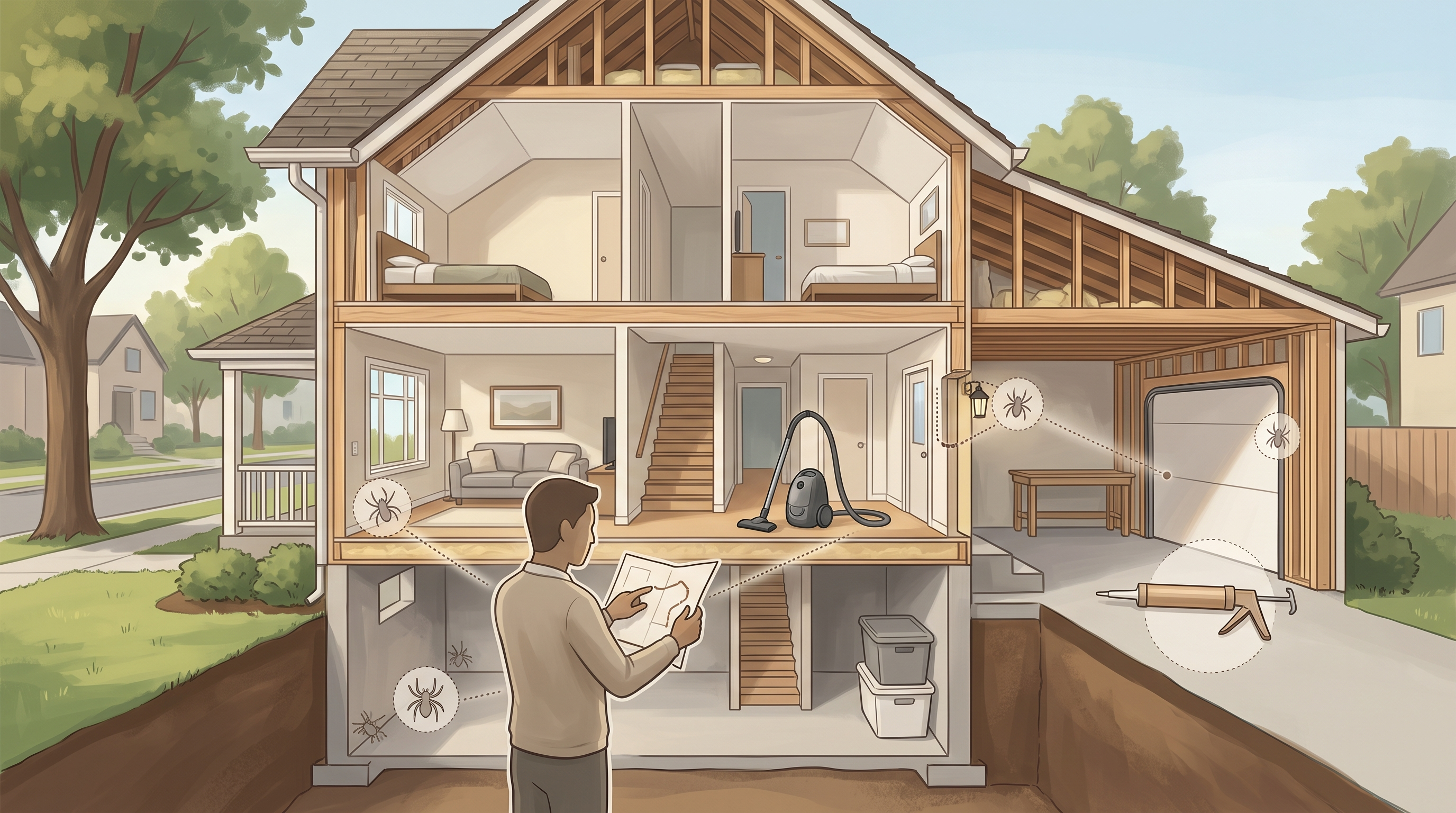
Create a simple home map and mark doors, windows, vents, utility penetrations, basement corners, garages, storage zones and exterior lights. Add the date for each sighting or web. This separates a persistent location from random movement and gives a professional better information if you later request help.
Look for associated evidence without tearing into walls or entering unsafe spaces. Small flying insects near lights, ants around a food source, gaps at a door sweep, cardboard stored against a wall or damp conditions can make a zone more attractive. Spiders often follow prey and shelter; reducing those conditions can be more useful than repeatedly removing only the visible web.
Bugman Plus currently lists Spider/Wasp Control among its services, but its public page does not publish a spider-specific treatment formula. A map of locations, timing and attempted fixes makes an eventual inquiry more specific without assuming what treatment a provider will recommend.
Remove reachable webs and spiders without spreading risk
For reachable, ordinary housekeeping situations, a vacuum with an extension tool or a broom can remove webs and egg sacs while keeping hands away. Dispose of vacuum contents according to the appliance instructions and your local waste practices. Wear appropriate household protection for dusty areas and do not stand on unstable furniture to reach a ceiling or exterior eave.
University of Minnesota Extension’s spider guidance includes removing webs with a broom, vacuum or hard spray of water as a physical-control measure. Follow the conditions of your own home: water is not appropriate near electrical equipment, indoors or where it can damage materials.
After removal, record whether and how quickly the web returns. A clean corner that remains clear requires a different next step from a corner rebuilt repeatedly. Evidence after an intervention is more informative than the original sighting alone.
Reduce shelter, prey, moisture and lighting attraction
Make inspection paths visible
Move stored items slightly away from walls where it is safe, reduce loose piles and use closed containers for long-term storage. The goal is not a perfect basement; it is a visible perimeter where new activity can be noticed and cleaned. Avoid moving heavy or contaminated material without appropriate help.
Address other insects
Spiders need prey. Clean food residues, manage waste, repair screens and investigate persistent flying or crawling insects rather than treating the spider as an isolated event. Different pests require different controls, so do not reuse a product simply because it was already in the cupboard.
Review moisture
Leaks, condensation and damp storage areas can support other insects and create sheltered conditions. Correct only maintenance issues within your competence. Electrical, structural, plumbing or mould concerns deserve the appropriate trade or professional assessment.
Reconsider exterior lighting
Lights near doors and windows can gather flying insects. Where safety permits, consider fixture placement, timing or shielding that reduces attraction at an entry. Do not compromise safe illumination of steps, walkways or entrances.
Close entry points only after observing the route
Inspect door sweeps, weather stripping, screens, utility openings and cracks around frames. Seal a practical gap with a material suitable for that location and surface, following the manufacturer’s instructions. Do not block required ventilation, drainage, weep holes, combustion-air openings or building systems.
Prioritize high-confidence gaps connected to repeated activity. Sealing every visible line in an older home without understanding its function can create other problems. For uncertain openings, ask a building professional before altering them.
Exterior vegetation and stored objects touching the structure can provide routes and shelter. Create reasonable separation where it is safe and permitted, but do not damage landscaping, utilities or building components. The goal is fewer easy transitions into the home, not a biologically sterile yard.

Keep pesticide use inside the label and Ontario rules
Nonchemical steps are not a licence to improvise with chemical products later. Health Canada’s pesticide safety guidance says to read the label before purchase and use, confirm that the label covers the intended pest and location, avoid using an outdoor product indoors and never mix pesticides unless the label instructs you to do so.
Ontario’s pesticide-class guide explains that homeowners can purchase and use certain Class D products on their own property or hire a licensed exterminator, while federal registration and provincial rules both matter. The exact product, site and use control what is permitted. This guide does not recommend a product or active ingredient.
Keep children and pets away according to the label, store products in their original containers and follow disposal directions. If the label does not clearly authorize the pest, location and use you have in mind, do not guess. Ask the manufacturer, regulator or a qualified professional.
Know when a professional assessment adds value
Consider help when activity repeats after cleaning and exclusion, appears across multiple zones, involves inaccessible voids or heights, occurs near sensitive occupants, or cannot be investigated safely. A professional conversation should begin with evidence and questions, not an assumed chemical solution.
- Describe locations, frequency and dates.
- Share photos only as supporting evidence, not a demand for certainty.
- List web removal, cleaning, moisture and sealing already attempted.
- Ask what inspection is included before treatment is proposed.
- Ask what pest and locations the plan covers.
- Request the product name and registration information if a pesticide is proposed.
- Ask about preparation, re-entry, pets, follow-up and written terms.
- Verify any required operator or exterminator credentials through the appropriate Ontario source.
Bugman Plus provides a current quote-request route and contact page. Use them to confirm present service area, availability, inspection, credentials, products, preparation, pricing, warranty and follow-up; none is assumed here.
Use this seven-day homeowner action plan
- Day 1: map sightings and photograph locations, not just the spider.
- Day 2: vacuum reachable webs and clear inspection paths.
- Day 3: check screens, door sweeps and high-confidence gaps.
- Day 4: address food residue, waste and other visible insect activity.
- Day 5: review moisture and exterior lighting near entry points.
- Day 6: recheck mapped zones for new evidence.
- Day 7: continue monitoring if activity declines or request an assessment if it persists.
The calendar is a planning aid, not a promise of control within seven days. Some activity is seasonal, some sources are hidden and some repairs take longer. Use the final check to choose the next action based on evidence.
Spider control mistakes that waste effort
- Spraying first and inspecting later. You lose evidence and may misuse a product.
- Calling every sighting an infestation. Frequency and pattern matter.
- Ignoring insect prey. Repeated spiders may follow another pest issue.
- Sealing functional openings. Do not block ventilation or drainage.
- Using outdoor products indoors. The label and location must match.
- Mixing products. Never create your own formula.
- Assuming a provider's credentials or guarantee. Verify current details directly.
Frequently asked questions
Why do spiders keep returning to the same corner?
The location may offer shelter, prey or a useful entry route. Remove the web, inspect nearby gaps and insects, and observe whether the pattern returns before choosing the next step.
Should I use a pesticide for one spider?
Not automatically. Safe removal and monitoring may be enough for an isolated sighting. If you consider a product, the registered label and applicable Ontario rules control its use.
Can a photo identify a dangerous spider?
A photo may support an expert assessment, but image quality and look-alike species limit certainty. Do not make a health or handling decision from a casual online identification.
When should I call a pest-control provider?
When activity is persistent, widespread, inaccessible, uncertain or beyond your safe capacity. Bring a location map and ask for inspection, written scope and verified product or credential details.
Request a spider-control assessment from Bugman Plus
Review Bugman Plus’s current service list, then use the owned quote route or contact page. Share the mapped locations, timing and steps already taken, and confirm current service area, inspection process, credentials, proposed product and label, preparation, price, follow-up and written warranty terms before authorizing work.
General household pest-planning information only; not species identification, pesticide instruction, medical advice, legal advice or a treatment guarantee. Follow registered labels, Ontario requirements and qualified guidance for your situation.


